Global Human Rights Centre (GHRC) delivers evidence-based research, expert advisory services, and climate mitigation innovations to support climate-vulnerable rural communities. We work with governments, businesses, investors and civil society to empower young rural women, ensuring they are financially included, less vulnerable to economic shocks and remain key drivers of resilient and sustainable food systems.
Chisomeje Rural Women Rising Project (CRWRP), as a flagship programme of the GHRC, translates these principles into action by empowering rural women in climate-vulnerable agrifood systems. The initiative builds self-sustaining, climate-resilient enterprises and strengthens women’s economic agency through social innovation, inclusive market access, and rights-based capacity development.
Together, GHRC and Chisomeje Rural Women Rising advance a shared mission: to transform global agrifood systems into equitable, sustainable, and rights-affirming ecosystems where rural women are recognised, resourced, and rewarded as central drivers of climate resilience, food security, and social justice.
Mission Statement
At the heart of our mission is the recognition that rural women in agrifood systems are not passive beneficiaries but powerful economic actors, farmers, traders, processors, and innovators who sustain households, nourish communities, and anchor local food security. Despite their critical role in the agricultural value chain, most rural women operate within the informal economy, facing systemic barriers such as limited access to finance, technology, markets, and land ownership. They often lack formal employment benefits, social protection, and legal recognition, making them highly vulnerable to climate shocks, economic instability, and policy neglect.
Our mission is to transform these vulnerabilities into opportunities for resilience, equity, and empowerment. We design and scale self-sustaining, climate-resilient enterprises and projects that enable rural women to thrive as business owners, leaders, and innovators in agrifood systems. Through an integrated approach that combines social innovation, inclusive market access, and rights-based development, we build pathways for women to move from survival to sustainability.
We achieve this by:
• Strengthening economic agency: Equipping women with the tools, training, and resources to establish and manage profitable, climate-smart agribusinesses.
• Embedding climate resilience: Promoting adaptive agricultural practices, renewable energy technologies, and sustainable value chains that reduce vulnerability to environmental shocks.
• Advancing equity and inclusion: Addressing structural inequalities in access to land, finance, markets, and decision-making, ensuring women’s voices shape local and national food policies.
• Driving systemic change: Partnering with governments, investors, and the private sector to integrate gender-responsive climate strategies into agricultural development and rural economic planning.
Our ultimate goal is to create a future where rural women are recognised, resourced, and rewarded as central drivers of food security, sustainable livelihoods, and climate resilience, ensuring that no woman is left behind in the transformation of agrifood systems.
Framework for Delivering Support for Rural Women in Climate-Vulnerable Agrifood Systems
STAGE I
Contextual Assessment and Participatory Design
We begin at the grassroots level to:
• Conduct Participatory Rural Appraisal (PRA): Engage rural women directly to identify their livelihood constraints, traditional knowledge, and local adaptive practices.
• Map Climate Vulnerabilities: Assess how droughts, floods, or erratic rainfall affect specific value chains (e.g., cassava, rice, tomatoes, or shea butter).
• Understand Power Dynamics: Examine land tenure systems, gender norms, access to finance, and decision-making barriers.
Output: Gendered Climate Vulnerability and Livelihood Assessment (GCVLA) Report
We will produce a comprehensive Gendered Climate Vulnerability and Livelihood Assessment (GCVLA) Report, providing an evidence-based analysis of how climate change disproportionately affects rural women’s livelihoods, access to resources, and economic participation within agrifood systems.
This report will go beyond baseline data collection. It will serve as a strategic instrument for shaping implementation priorities and informing multi-stakeholder decision-making. The GCVLA will:
- Identify Differential Vulnerabilities: Examine how climate impacts vary across gender, age, socioeconomic status, and land tenure, highlighting the structural barriers that limit women’s adaptive capacity.
- Map Livelihood Systems: Document the economic activities, informal value chains, and ecosystem services that sustain rural women’s incomes, while assessing how climate stressors disrupt these systems.
- Integrate Local and Indigenous Knowledge: Capture women’s experiential insights and traditional adaptation strategies as vital inputs for context-specific resilience planning.
- Assess Institutional and Policy Gaps: Analyse existing government and community-level adaptation frameworks to identify where gender considerations are absent or weakly implemented.
- Recommend Targeted Interventions: Provide actionable guidance for policymakers, investors, and businesses to design gender-responsive, climate-resilient investments and livelihood programmes.
- Inform Policy and Private Sector Action: Serve as a cornerstone for developing inclusive policy frameworks—enabling government agencies, financial institutions, and agribusinesses to understand on-the-ground realities and implement mitigation measures aligned with national climate adaptation strategies and the SDGs.
Ultimately, the GCVLA will not only guide our implementation process but also establish a knowledge foundation that supports evidence-based planning, resource allocation, and impact monitoring for equitable and sustainable climate adaptation in rural agrifood systems.
TIME FRAME. 3-6 Months
STAGE II
Define the Value Proposition
Design around women’s strengths and local resources:
- Identify high-value, low-carbon agricultural opportunities (e.g., organic vegetables, millet, moringa, mushrooms, honey).
- Build inclusive business models that link women to value chains as producers, processors, and distributors – not just labourers.
- Ensure the project integrates climate-smart practices such as agroforestry, drip irrigation, solar drying, and composting.
- Support those businesses to thrive and grow.
Solution and Outcome
The project proposes to empower local communities through the establishment of Vegetable-Growing Hoop House Farm Greenhouses and Solar Drying Domes, creating an integrated climate-smart system for sustainable food production, processing, and income generation. This dual approach addresses both production and post-harvest challenges, ensuring year-round cultivation, reduced food loss, and enhanced economic resilience for smallholder farmers, particularly women and youth.
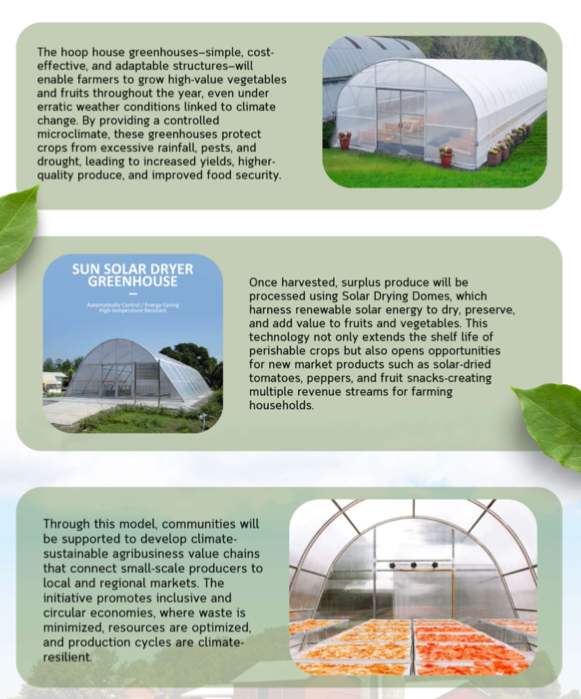
Beyond immediate food preservation, the solution supports the creation of sustainable local business models built around climate-smart agro-processing. Farmer cooperatives and community-based enterprises will be trained to manage and operate the domes as income-generating ventures, integrating principles of inclusive green entrepreneurship. The initiative will strengthen local value chains, enhance rural livelihoods, and promote equitable participation—particularly for women who are often excluded from higher-value agricultural markets.
Moreover, the Solar Drying Domes will contribute to climate mitigation and adaptation by utilising renewable solar energy rather than firewood or fossil fuels, thereby reducing carbon emissions and deforestation. Complementary capacity-building activities will focus on business development, market access, food safety standards, and packaging techniques, ensuring that communities can transition from subsistence farming to sustainable agribusiness models.
Capacity-building programs will be integral to the project, providing training on:
- Greenhouse management and organic production techniques;
- Efficient use of water and renewable energy;
- Food safety, hygiene, and packaging standards;
- Business development, cooperative management, and access to finance;
- Market linkages and digital marketing for solar-dried products.
By combining climate-smart cultivation with solar-based preservation, the initiative ensures that farmers can grow, process, and market their produce sustainably—transforming subsistence farming into profitable, environmentally responsible enterprises.
This solution delivers a fourfold impact and win:
- Climate Resilience: Enables year-round cultivation and reduces vulnerability to extreme weather.
- Environmental Sustainability: Promotes renewable energy use, efficient water management, and reduced food waste.
- Economic Empowerment: Creates green jobs, enhances income opportunities, and supports women- and youth-led enterprises.
- Food Security and Nutrition: Increases the availability of affordable, nutrient-rich vegetables and fruits in local markets.
Ultimately, the initiative establishes a self-sustaining rural agro-innovation ecosystem where local communities are not only adapting to the climate crisis but thriving through innovation, inclusion, and sustainability.
SIDELINES
Finance and Ownership Models
Women’s economic agency depends on access to capital and control over assets.
- Establish Micro-Grants or Climate Resilience Funds: Seed funding for women’s cooperatives or agrifood startups.
- Ensure Legal Ownership Rights: Support women to register their enterprises and secure land use titles.
Capacity Development and Technology Transfer
Equip women with:
- Technical Skills: Climate-smart agriculture, digital literacy, post-harvest technologies, and agro-processing techniques.
- Business Skills: Cooperative governance, bookkeeping, market analysis, and supply chain management.
- Foster Corporate Partnerships: Connect rural women’s produce to inclusive procurement programmes of agribusinesses and retailers.
Digital Climate Advisory Centres that train women via WhatsApp or community radio on adaptive agronomic techniques.
STAGE III
Monitoring, Evaluation, and Impact Measurement
Use Gender-Responsive and Human Rights-Based Indicators, such as:
- Women’s income and asset ownership levels
- Reduction in gender labour burden
- Adoption rate of climate-resilient practices
- Market penetration and profitability of women’s enterprises
- Environmental indicators (soil health, biodiversity, emissions avoided)
Frameworks: Align with SDG 5 (Gender Equality), SDG 8 (Decent Work), SDG 13 (Climate Action), and SDG 2 (Zero Hunger).
Scaling and Sustainability
- Replicate successful models.
- Leverage Diaspora and Private Sector Partnerships: For export markets and technical mentorship.
- Promote Ethical and Sustainable Branding: Position products as “climate-resilient, women-powered” to attract ethical consumers.
- Engage Governments: Integrate the project into national gender and climate adaptation policies.